The Shot That Saved Psycho
Alfred Hitchcock didn't improvise the shower scene in Psycho. He storyboarded all 70+ cuts across 45 seconds of screen time. Every camera angle, every edit point, every flash of movement was planned on paper before Janet Leigh stepped into that bathroom.
The result? A scene that's studied in every film school on earth. Not because of the violence — by today's standards it shows almost nothing — but because of the editing rhythm. That rhythm was designed in the storyboard, not discovered in the edit suite.
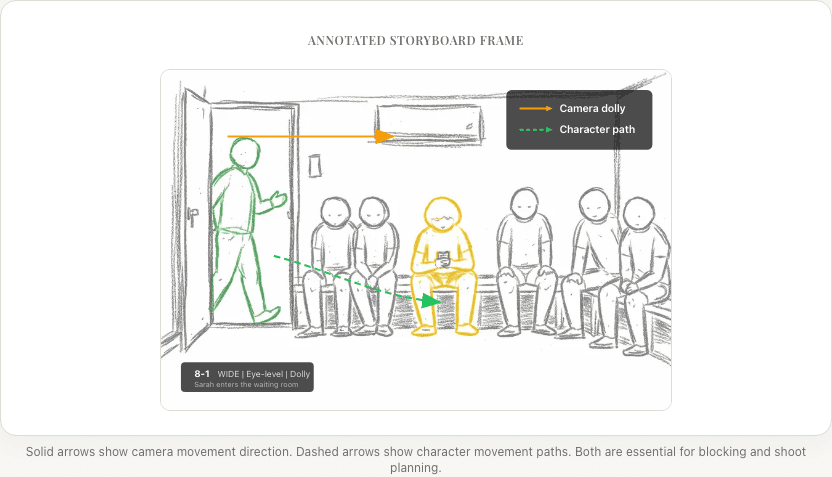
Hitchcock's boards for Psycho reveal something important about storyboarding: it's not about drawing skill. It's about thinking in sequences. His boards were simple — clean compositions with minimal detail. What made them extraordinary was the precision of the cutting logic built into the sequence.
Ridley Scott: The Director as Visual Architect
Ridley Scott is arguably cinema's most famous storyboarder. A trained painter and graphic designer, he creates his own boards for every film — detailed, atmospheric drawings that function as both pre-production tools and standalone art.
His storyboards for Blade Runner (1982) are the gold standard. Each frame captures not just composition but mood: the neon reflections, the smoke, the layered depth of the dystopian cityscape. His boards for the Deckard/Rachel first meeting show exactly the lighting, camera height, and set depth he wanted.
But here's the thing most people miss when they see Scott's boards: the drawing quality isn't what makes them useful. What makes them useful is that his DP, Jordan Cronenweth, could look at a frame and immediately understand the shot — camera position, lighting direction, depth of field, and emotional temperature. The drawing was the delivery mechanism for directorial decisions.
Directors who can't draw to Scott's standard still need to communicate the same information. The decisions are the same. Only the delivery mechanism changes.
Steven Spielberg: Stick Figures That Changed Cinema
Spielberg's early storyboards are famously rough. The boards for Raiders of the Lost Ark (1981) — drawn by Spielberg himself and storyboard artist Ed Verreaux — look nothing like Ridley Scott's polished illustrations. They're quick, loose sketches with stick-like figures and basic composition lines.
They also planned one of the most perfectly executed action films ever made.
The boulder chase, the truck chase, the Well of Souls — every set piece was boarded in detail. Not detailed in terms of art quality, but in terms of editorial planning. Spielberg knew which shots he needed, how they cut together, and where the coverage gaps would be.
His approach proves an essential truth: storyboarding is a planning discipline, not an artistic discipline. The quality of thinking matters infinitely more than the quality of drawing.
For the truck chase sequence, Spielberg boarded every major beat: the hero's approach, the fight on the truck, the transitions between wide action and close-up drama. Each board carried annotations — camera movement, timing, stunts. The finished sequence matches the boards almost exactly.
Martin Scorsese: Words Over Pictures
Scorsese represents the opposite end of the visual spectrum from Ridley Scott. His "storyboards" for Taxi Driver (1976) were primarily text-based — detailed shot descriptions with occasional overhead diagrams showing camera and character positions.
For the famous "You talkin' to me?" scene, Scorsese's notes described: mirror angle, Travis Bickle's position, the gun draw, the escalating intensity of the monologue. No elaborate drawings. Just a director with a clear vision of what each shot needed to accomplish emotionally.
This approach works because Scorsese's key collaborator — cinematographer Michael Chapman on Taxi Driver — understood his visual language from years of collaboration. The text descriptions were sufficient because both director and DP shared a visual vocabulary.
For directors working with new collaborators (which describes most indie filmmakers), visual boards communicate more clearly than text. But Scorsese's approach reminds us: the storyboard format doesn't matter. What matters is that the shot intent is communicated.
The Coen Brothers: Precision Planning, Every Frame
Joel and Ethan Coen storyboard every shot of every film. Their boards for No Country for Old Men (2007) and Fargo (1996) demonstrate almost obsessive planning — each frame precisely composed, each transition mapped.
Their cinematographer, Roger Deakins, has said he's never worked with directors who plan so thoroughly. By the time cameras roll, there's no discussion about where the camera goes. The storyboard settled that.
The Coens' approach yields a specific benefit: maximum efficiency on set. Because every shot is planned, they consistently finish shooting days ahead of schedule and under budget. The storyboard investment pays for itself in production savings.
Hayao Miyazaki: Storyboards as Filmmaking
Miyazaki occupies a unique position because his storyboards essentially are his films. For Studio Ghibli productions, Miyazaki draws every storyboard frame himself — thousands of them per film. The animators then follow these boards almost exactly.
His boards for Spirited Away (2001) show remarkable detail: character expressions, background elements, camera movements, timing marks. Each frame carries more information than most directors' final storyboards because it has to — it's the primary communication document for the entire animation team.
What makes Miyazaki's boards instructive for live-action directors isn't the art quality (which is extraordinary). It's the information density. Each frame communicates: composition, character emotion, movement direction, timing, and relationship to adjacent frames. That's the standard all storyboards should aspire to, regardless of the visual medium.
What These Examples Actually Teach Us
Looking across Hitchcock, Scott, Spielberg, Scorsese, the Coens, and Miyazaki, a pattern emerges:
The storyboard's value has nothing to do with artistic quality. Spielberg's stick figures and Scott's paintings serve the same function: communicating shot intent to the crew and planning the editorial sequence.
Every great director plans. The method varies — drawings, text, diagrams, AI-generated frames — but the discipline of thinking through shots before shooting them is universal among master filmmakers.
The storyboard is a thinking tool, not just a communication tool. The act of planning shots forces you to confront problems: coverage gaps, spatial impossibilities, pacing issues, continuity breaks. These are cheaper to solve on paper than on set.
Consistency beats perfection. The Coens board every shot of every film. That consistency is what makes their production process so efficient. A director who storyboards some scenes but not others gets the benefits inconsistently.
How This Applies to Your Film
You're not making Blade Runner or Raiders of the Lost Ark. But you face the same fundamental challenge: turning a screenplay into a visual plan that your crew can execute.
The directors above used whatever tools and methods matched their skills:
- If you can draw → sketch your boards (Spielberg's approach)
- If you think in words → write detailed shot descriptions (Scorsese's approach)
- If you're meticulous → board every shot (Coen brothers' approach)
- If you need speed → use AI tools to generate frames from your screenplay
The method doesn't matter. The discipline does.
Ready to speed up your pre-production?
StoryBirdie turns your screenplay into a professional storyboard in minutes. See pricing or jump straight in.
About the author
Aayush is co-founder and director at StoryBirdie. He's a screenwriter, director, stand-up comedian, and full-stack developer — co-founder of Kathmandu's Comedy Tuk Tuk, with directing and writing credits on shorts, music videos, and comedy projects. He builds StoryBirdie on the conviction that storyboarding is expensive, time-consuming, and important — and that a tool for it should serve the filmmaker's vision, not replace it. StoryBirdie is currently in use on a Nepali feature, a Sri Lankan TV commercial, and at one of Nepal's largest production houses. Based in Kathmandu, Nepal.
Keep reading
- Storyboard vs Animatic: What's the Difference?Storyboards and animatics serve different purposes in pre-production. Learn when to use each and how they work together.·10 min read
- How to Storyboard a Commercial: A Director's WorkflowStoryboarding a commercial: timing, product shots, client-approval drafts, and the agency workflow that keeps clients and crew aligned.·8 min read
- How to Storyboard a Dialogue SceneCamera angles, shot sizes, and pacing strategies for storyboarding dialogue. Practical coverage patterns every director should know.·8 min read
- How to Storyboard a Fight SceneStoryboard fight scenes that are clear, impactful, and editable. Covers choreography beats, camera placement, and cutting rhythm for action.·8 min read