Script-Level Continuity Errors Cost Real Money
I once lost a full reshoot day because nobody caught a wardrobe inconsistency hiding in the script. Two different outfits for the same character in back-to-back scenes, right there on the page, and we all missed it.
That wasn't an on-set mistake. It was a script-level continuity error, and it could have been caught for free during prep with a careful read.
Continuity Errors Start in the Script, Not on Set
When people think of continuity errors, they picture the on-set classics: a coffee cup that changes hands between shots, a wound that disappears between scenes. Those happen because of lapses during shooting.
But many continuity errors don't start on set. They start in the screenplay itself, and they're far cheaper to catch on paper than in post-production (or worse, in reshoots).
A character who's established as left-handed in scene 2 but draws a gun with their right hand in scene 40. A scene set "the next morning" that contradicts the timeline from three scenes earlier. A car that was destroyed in act one but reappears in act three without explanation.
These aren't on-set mistakes. They're script-level failures that cascade into production problems if nobody catches them.
The Five Types of Script Continuity (And the Sneaky Ways Each One Breaks)
1. Temporal Continuity: "Wait, What Day Is It?"
Temporal continuity tracks the passage of time across the screenplay. Every scene exists at a specific point in the story's timeline, and those points need to be logically consistent. Writers rearrange scenes during revisions all the time, and the time-of-day markers don't always follow.
What to check:
- Scene heading time of day. If scene 10 is "NIGHT" and scene 11 is "MORNING," is scene 12 later that same morning or the following morning? Ambiguity here causes scheduling confusion and potential lighting mismatches.
- Story-time gaps between scenes. If a character says "I'll meet you in an hour" in scene 5, and scenes 6 through 8 happen at other locations, does scene 9 (the meeting) occur approximately one hour later in story time?
- Day counts. Some scripts span specific timeframes like "the events of one weekend" or "three days before the trial." Track each scene's day number. If the story covers three days but your scenes imply five, something's wrong.
- Seasonal and weather consistency. If act one establishes winter (snow, heavy coats), act two shouldn't have characters at an outdoor barbecue unless significant time has passed.
- Flashback and flash-forward markers. Every non-linear time jump should be clearly marked. If the audience (and crew) can't tell whether scene 15 happens before or after scene 14, the script needs revision.
A common example:
SCENE 20 - INT. OFFICE - MORNING
Sarah arrives at work, coffee in hand.

SCENE 21 - EXT. PARKING LOT - NIGHT (PREVIOUS EVENING)
Sarah walks to her car after working late.

SCENE 22 - INT. SARAH'S APARTMENT - MORNING
Sarah wakes up, checks her phone.
Scene 22 is a trap. Is it the same morning as scene 20 (making scene 21 a flashback), or a different day? This ambiguity affects wardrobe, hair, and the audience's understanding of the timeline. Even experienced script supervisors miss this kind of thing because it looks fine on a quick read.
2. Spatial Continuity: "How Did They Get There So Fast?"
Spatial continuity ensures that the physical world of the screenplay makes geographic sense. This tends to sneak in when the writer is focused on emotional beats and forgets that characters have to physically travel between locations.
What to check:
- Character travel. If a character is at Location A in scene 5 and Location B in scene 6, can they plausibly travel between those locations in the implied time gap? If Location A is New York and Location B is Los Angeles and the scenes are the same afternoon, someone needs a plane ticket or the script needs a fix.
- Location layout. If scene 3 describes a one-bedroom apartment, scene 15 shouldn't have the character hosting six guests in a "spacious living room" at the same address.
- Geography. A character who lives on the coast shouldn't be driving to the beach for two hours (unless that's plot-relevant).
- Interior-exterior consistency. If the exterior establishing shot shows a small rural house, the interior shouldn't feel like a mansion.
A classic spatial error:
SCENE 8 - EXT. DOWNTOWN RESTAURANT - NIGHT
James and Sarah leave the restaurant.

SCENE 9 - INT. JAMES'S APARTMENT - NIGHT (CONTINUOUS)
James pours two glasses of wine.
"CONTINUOUS" means no time has passed. But going from a downtown restaurant to an apartment takes travel time. Either remove "CONTINUOUS" or add a brief transition. This one sneaks past everyone because the emotional continuity is perfect; the intimate mood carries over. But your editor will have a nightmare making it work.
3. Character State Continuity: "Did He Forget He Got Punched?"
This is the one audiences actually notice. Characters are physical and emotional beings, and their states need to be tracked across the screenplay.
What to check:
- Injuries and physical changes. If a character breaks their arm in scene 12, they should be wearing a cast in every subsequent scene. If a character gets a dramatic haircut in scene 20, it shouldn't be back to normal in scene 25.
- Emotional arcs. If a character receives devastating news in scene 15, they shouldn't be cheerfully joking in scene 16 (unless the contrast is intentional, and if so, another character should notice).
- Knowledge state. This is a big one. If a character learns a secret in scene 10, their behavior in scenes 11 onward should reflect that knowledge. The reverse is also true: a character shouldn't reference information they haven't learned yet.
- Relationship states. If two characters have a falling-out in scene 18, they shouldn't be friendly in scene 22 without a reconciliation scene between them.
- Intoxication, fatigue, and other temporary states. A character drinking heavily in scene 7 shouldn't be sharp and clear-headed in scene 8 (set 20 minutes later) without the screenplay acknowledging it.
The "knowledge leak" is the sneakiest one. It happens because the writer knows the full plot and forgets which characters know what at each point:
SCENE 14 - INT. POLICE STATION - DAY
Detective Rivera discovers the victim's identity.

SCENE 15 - INT. SUSPECT'S HOUSE - DAY
(Rivera hasn't been to the station yet in story time)

          RIVERA
   We know who the victim is, Mr. Chen.
If scene 15 happens before scene 14 in story time, Rivera can't have this information. The writer usually says "Oh, I moved that scene during the last rewrite." That's almost always how it happens.
4. Prop and Wardrobe Continuity: "Where Did the Coffee Cup Go?"
Objects and clothing have to be tracked across scenes. This is the stuff that prop departments lose sleep over, and it starts in the script.
What to check:
- Prop persistence. If a character picks up a letter in scene 5 and the next scene is continuous, they should still be holding it. It shouldn't vanish.
- Wardrobe across same-day scenes. Scenes on the same story day should have characters in the same clothes unless there's a reason to change.
- Prop damage. If a phone screen cracks in scene 10, it should be cracked in scene 14 too, unless they got a new one.
- Vehicles. If a character's car is a red Toyota in scene 3, it shouldn't become a blue Honda in scene 30.
- Meaningful props. Wedding rings, glasses, badges, weapons. These carry story significance. Track them scene by scene.
This one seems minor until it isn't:
SCENE 7 - INT. KITCHEN - MORNING
Sarah puts on her glasses and reads the newspaper.

SCENE 8 - INT. LIVING ROOM - MORNING (CONTINUOUS)
Sarah looks out the window, squinting at something.
Continuous scene. She just put on glasses. Why is she squinting? Either she took them off (which the script should note) or this is a continuity slip. An audience member will notice and think "wait, didn't she just..." and now they're thinking about glasses instead of your story.
5. Logic and World-Building Continuity: "But You Said the Building Has Security..."
The rules of your story's world need to be internally consistent. Break your own rules and the audience stops trusting you.
What to check:
- Established rules. If your thriller shows a state-of-the-art security system in scene 4, the villain can't walk through the front door in scene 20 without addressing how they bypassed it.
- Character abilities. If a character can't swim, they shouldn't dive into a river in act three without setup.
- Technology. If the story is set in 2005, no smartphones. If a character's phone dies in scene 12, they can't make a call in scene 13 without charging it.
- Tonal consistency. A grounded crime drama that suddenly introduces supernatural elements in act three has a tonal continuity problem (unless the shift is earned).
A Systematic Approach to Catching These Errors
Catching continuity errors isn't about having a superhuman memory. It's about having a system.
Build a Timeline
Create a chronological timeline of your story. For each scene, note the scene number, story day and approximate time, location, characters present, and key events. This timeline is your master reference. Every continuity check starts here.
Track Characters Across the Timeline
For each character, create a thread that follows them through the timeline: where are they, what do they know, what's their physical and emotional state, what are they wearing and carrying? When a character appears in a new scene, compare their state to their last appearance. Any change should be justified by story events.
Track Props and Objects
List every significant prop in the screenplay. For each one, note when it's introduced, which scenes it appears in, any changes to its state (broken, lost, moved), and when it exits the story.
Check Scene Transitions
Go through every consecutive pair of scenes and check: Is the time jump clear and logical? Can characters get from point A to point B in the implied time? Are there state changes that need to be addressed? Does the transition feel intentional or accidental?
Cross-Reference Dialogue Against Action
Check whether characters say things that contradict what's happened in the script. A character referencing an event that hasn't happened yet, claiming they were somewhere they weren't, or describing something inaccurately. Most are errors, but some are intentional (the character is lying). When you find one, determine which.
The Tools: From Spreadsheets to AI
The Continuity Spreadsheet
The old-school approach: a spreadsheet with scenes as rows and tracking elements (characters, props, wardrobe, time) as columns. Fill in each cell for every scene. Gaps and inconsistencies become visible when you scan the columns.
I used this for years. It works. It's also incredibly tedious, and by page 80 of a feature, your attention is slipping. Which is exactly when the errors are hiding.
The Colored Script
Print the screenplay and attack it with highlighters:
- Blue for temporal markers
- Green for character states
- Yellow for props
- Pink for location details
Read through the script marking every relevant element. Then scan each color separately for consistency.
This works well for short films. There's something about physical paper that makes you read more carefully. But it doesn't scale for features, and it's useless when the script changes (which it always does).
AI-Powered Analysis
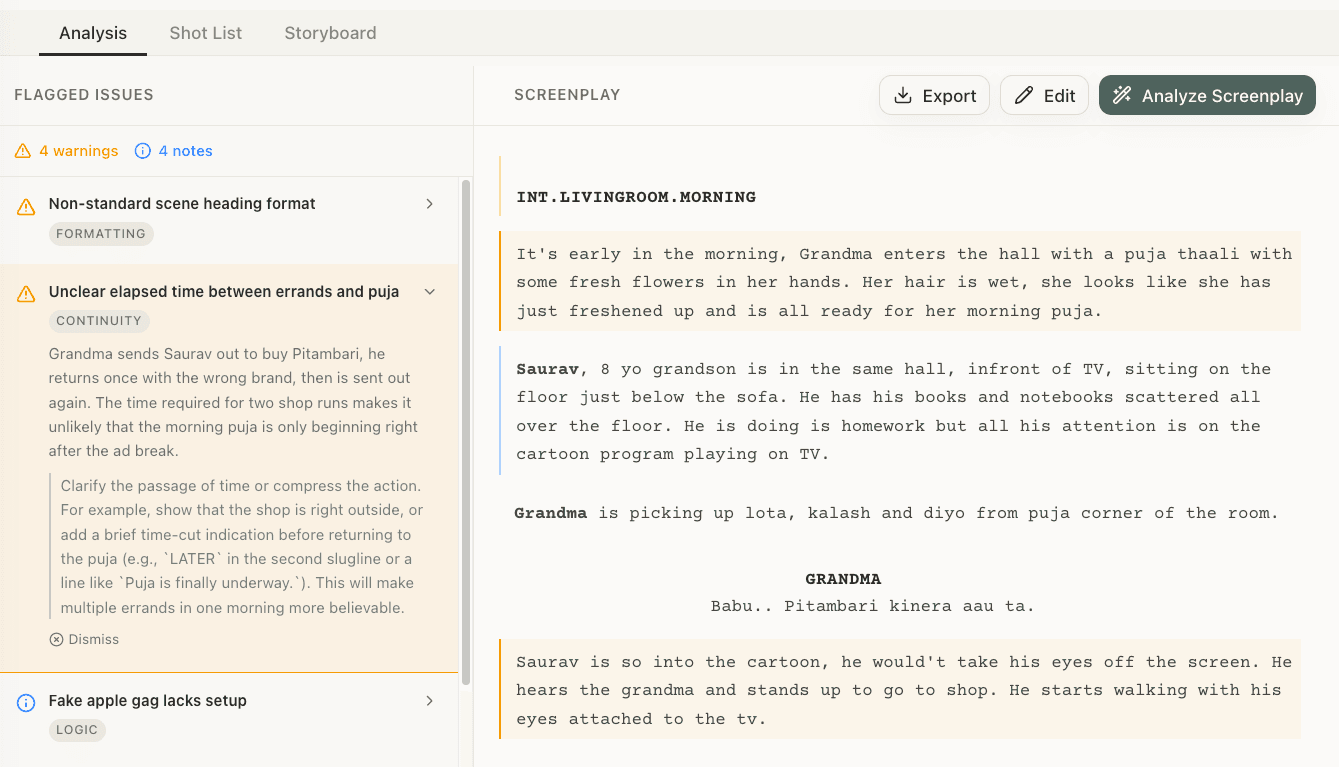
This is where the game has changed. Modern AI-powered tools can parse a screenplay and automatically flag potential continuity issues by:
- Extracting all characters, locations, props, and timeline markers
- Building a story timeline and character tracks
- Identifying scenes where tracked elements appear inconsistently
- Flagging potential issues for human review
The key word is "potential." AI flags possibilities; you use your creative judgment to decide which are real problems and which are deliberate storytelling choices. An unreliable narrator should have contradictions. A dream sequence should violate spatial rules. The AI doesn't know your intent. You do.
The best workflow combines AI detection with human verification. Let the tool do the tedious tracking, then apply your directorial brain to the results.
The Six Most Common Script Continuity Errors
These are the patterns that show up over and over across scripts:
1. The teleporting character. A character is in one location and magically appears in another with no travel time. Especially common after scene rearrangements during revisions.
2. The forgotten injury. A character breaks something, gets shot, gets punched, and it's never mentioned again. If the injury mattered enough to write, it matters enough to track.
3. The timeline accordion. The story stretches or compresses inconsistently. "The next day" doesn't align with other scenes' time references. Extremely common in scripts with parallel storylines.
4. The knowledge leak. A character acts on information they haven't received yet. Caused by the writer knowing the full plot and forgetting who knows what when. Extremely avoidable with proper tracking.
5. The disappearing prop. An important object appears when plot-convenient and vanishes otherwise. Chekhov said every gun on the wall must fire. The corollary: every gun that fires must have been on the wall.
6. The undone decision. "I'm done with this!" says the character in scene 12. Then in scene 14, they're fully back in it with no explanation. Usually caused by the writer changing their mind about the arc without revising earlier scenes.
When "Errors" Are Actually Choices
Not every inconsistency is a mistake. Good screenwriting sometimes breaks continuity on purpose:
- Unreliable narrators create intentional contradictions between what they say and what happened.
- Dream sequences and hallucinations may violate spatial and temporal rules by design.
- Deliberate time jumps can omit context that's later filled in (a wound appears with no explanation, then a flashback reveals the fight).
- Character lies create discrepancies between dialogue and established facts.
The difference: deliberate breaks serve the story and are eventually made clear. Accidental errors just confuse people.
When you flag a potential issue, always ask: Is this serving the story, or has someone simply lost track?
From Continuity Check to Pre-Production
Catching these errors isn't just about fixing the script. Your continuity notes become working documents for your entire crew, feeding directly into the screenplay-to-storyboard pipeline:
- Wardrobe uses your notes to plan costume changes across same-day scenes
- Props uses your tracking to ensure the right items are available for each scene
- Hair and makeup uses character-state tracking for injuries, aging, and appearance changes
- Script supervisor uses your timeline as their on-set continuity bible
- Your screenplay breakdown becomes more accurate because you've already mapped every persistent element
The continuity check is unglamorous prep work. But it makes everything downstream, from shot listing to storyboarding to the actual shoot, smoother and cheaper.
Every director learns this the hard way at least once. Better to catch these errors on the page than on set.
Check your script. Then check it again.
Ready to speed up your pre-production?
StoryBirdie turns your screenplay into a professional storyboard in minutes. See pricing or jump straight in.
About the author
Aayush is co-founder and director at StoryBirdie. He's a screenwriter, director, stand-up comedian, and full-stack developer — co-founder of Kathmandu's Comedy Tuk Tuk, with directing and writing credits on shorts, music videos, and comedy projects. He builds StoryBirdie on the conviction that storyboarding is expensive, time-consuming, and important — and that a tool for it should serve the filmmaker's vision, not replace it. StoryBirdie is currently in use on a Nepali feature, a Sri Lankan TV commercial, and at one of Nepal's largest production houses. Based in Kathmandu, Nepal.
Keep reading
- Screenplay Breakdown: How to Analyze a ScriptStep-by-step guide to screenplay breakdown. Learn scene analysis, element tagging, and how to turn a script into a shooting-ready plan.·8 min read
- AI Screenplay Analysis: Catch Script Problems Before They Cost YouHow AI screenplay analysis tools catch continuity errors, blocking issues, and production problems that human reads miss. Save reshoot days.·8 min read
- Screenplay to Storyboard: A Director's WorkflowA director's guide to turning a screenplay into a storyboard. Covers script analysis, shot lists, frame planning, and AI tools.·14 min read
- Storyboard vs Animatic: What's the Difference?Storyboards and animatics serve different purposes in pre-production. Learn when to use each and how they work together.·10 min read