The screenplay is finished. Everyone's celebrating. But for the director, the real work is just starting. Before a single frame is shot, before you even think about cameras or lenses, you need to take that script apart piece by piece and understand exactly what it's asking of your production.
That process is the screenplay breakdown.
What Is a Screenplay Breakdown?
A screenplay breakdown is the process of systematically analyzing every scene in a script to identify the elements needed for production. Cast, locations, props, wardrobe, special effects, time of day. Everything that costs money or requires planning gets pulled out of the script and catalogued.
It's the bridge between the creative writing phase and the practical reality of shooting a film.
For directors, the breakdown serves a dual purpose. It's both a production planning document and a creative analysis tool. While you're tagging props and locations, you're also making decisions about shot composition, blocking, and visual storytelling that will define your film.
Why Directors Should Lead the Breakdown
Many productions delegate the breakdown to an assistant director or production manager. That's fine for logistics, but the creative breakdown should involve the director from the start. I've seen too many directors hand this off entirely and then wonder why their shot list feels disconnected from the script.
- Shot decisions start here. When you analyze a scene, you're already deciding what matters visually. A prop mentioned once in the script might become a key visual motif if you recognize it during the breakdown.
- Continuity starts here. If a character picks up a coffee cup in scene 3 and it's gone in scene 5 (which takes place ten minutes later in story time), that's a continuity error hiding in the script. You catch these during breakdown, not on set.
- Budget conversations start here. Knowing exactly what each scene requires means you can have informed conversations with your producer about what's achievable.
The Step-by-Step Breakdown Process
Read the Full Script Without Marking Anything
Read it like an audience member first. Absorb the story, the characters, the rhythm. Note your emotional reactions. This reading informs every creative decision you'll make during the technical breakdown.
Number Your Scenes
If the screenwriter hasn't numbered the scenes, do it now. Every scene gets a unique number. A scene changes whenever there's a change in location or time, and these are indicated by scene headings (slug lines) like INT. DETECTIVE'S OFFICE - NIGHT.
Analyze Each Scene Header
Each scene heading tells you four things: Interior or exterior (INT./EXT.), which affects lighting, sound, and equipment; Location, meaning where you need to shoot; Time of day, which affects lighting and scheduling; and Story context, where this fits in the narrative arc. Create a scene list with these elements catalogued.
Tag Production Elements
Go through each scene and identify every production element. Use the table below as your checklist, and apply consistent color-coding (industry standard: red for cast, orange for extras, blue for SFX, green for props, yellow for wardrobe, purple for vehicles, pink for music/sound).
Go through each scene and identify:
| Element | What to Look For |
|---|---|
| Cast | Which characters appear? Speaking or non-speaking? |
| Extras | Background actors needed for the scene |
| Props | Objects characters interact with |
| Wardrobe | Specific clothing mentioned or implied |
| Vehicles | Cars, bikes, boats, anything that moves |
| Special effects | Practical effects, stunts, weather |
| VFX | Post-production visual effects |
| Sound | Music playback, specific sound requirements |
| Locations | Specific location requirements or constraints |
Check for Continuity Issues
This is where many breakdowns fall short, and honestly, where I find the most value in doing the work myself. Continuity checking means tracking elements across scenes to ensure logical consistency:
- Temporal continuity: Does the time of day make sense as scenes progress? If scene 4 is "MORNING" and scene 5 is "PREVIOUS NIGHT," is that intentional (flashback) or an error?
- Prop continuity: A character wearing glasses in one scene should have them in the next scene unless there's a story reason they're removed.
- Wardrobe continuity: If scenes are meant to take place on the same day, characters should be wearing the same clothes.
- Location logic: Can a character realistically get from Location A in scene 3 to Location B in scene 4 given the story's timeline?
- Character state: If a character gets injured in scene 6, they should show signs of that injury in subsequent scenes.
Create Scene Breakdown Sheets
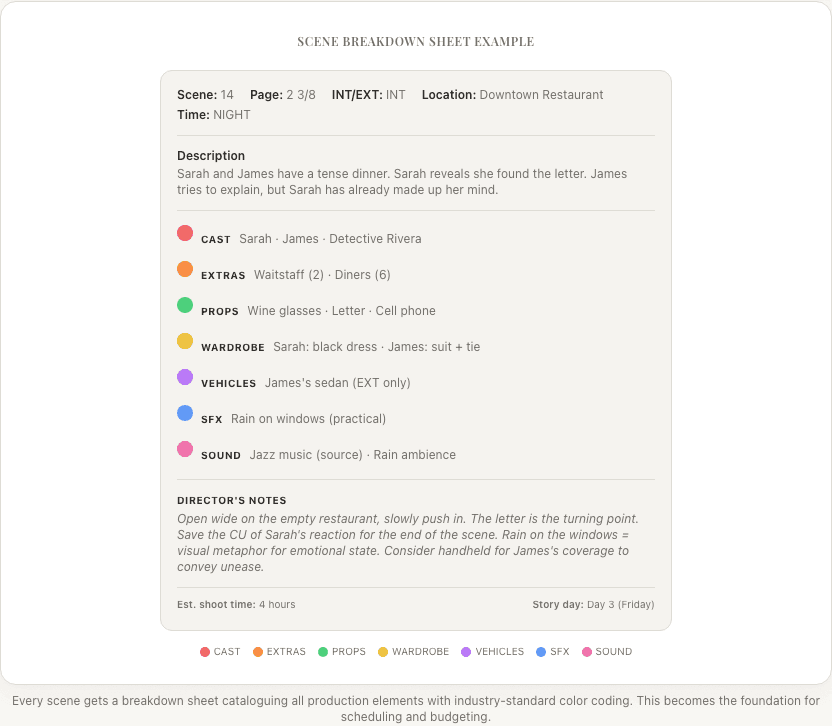
For each scene, create a breakdown sheet that consolidates:
- Scene number and description
- Page count (measured in eighths of a page, the standard unit)
- All tagged elements
- Any notes about tone, visual approach, or special requirements
- Estimated shooting time
These sheets become the raw material for your shooting schedule, budget, and shot list.
Build Your Scene-by-Scene Notes
As a director, add a layer beyond the standard production breakdown:
- Visual approach: What's the camera doing in this scene? Wide establishing shots? Tight close-ups? Handheld or locked-off?
- Emotional beats: What should the audience feel at each moment?
- Key moments: Which moments in the scene are the most important to capture?
- Blocking ideas: How do characters move through the space?
These notes become the foundation for your shot list and storyboard.
From Breakdown to Shot List
The breakdown feeds directly into the next phase of pre-production: creating a shot list. Each scene you've analyzed now needs to be translated into specific camera setups.
Your breakdown notes on visual approach and key moments guide this process:
- For each scene, review your director's notes
- Identify the essential beats that need coverage
- Determine what shot types best serve each beat
- Build your shot list with specific camera angles, movements, and framing
This is where tools like StoryBirdie become particularly valuable. Once you've uploaded your screenplay, the AI can generate an initial shot list based on the scene analysis, which you then refine with your creative vision.
Common Breakdown Mistakes
Skipping the first read. It's tempting to jump straight into technical analysis, highlighter in hand. Resist that. The story should drive your decisions, not the other way around. If you don't know how a scene feels, you can't make good choices about how to shoot it.
Inconsistent element tagging. If you call it a "cell phone" in scene 1 and a "smartphone" in scene 15, your props department has to figure out if that's one item or two. Pick your terms and stick with them.
Ignoring implied elements. The script says "Sarah enters the restaurant." It doesn't mention tables, chairs, menus, silverware, other diners, wait staff, ambient noise, or background music. Your breakdown needs to account for all of it. What the writer left out is still your problem.
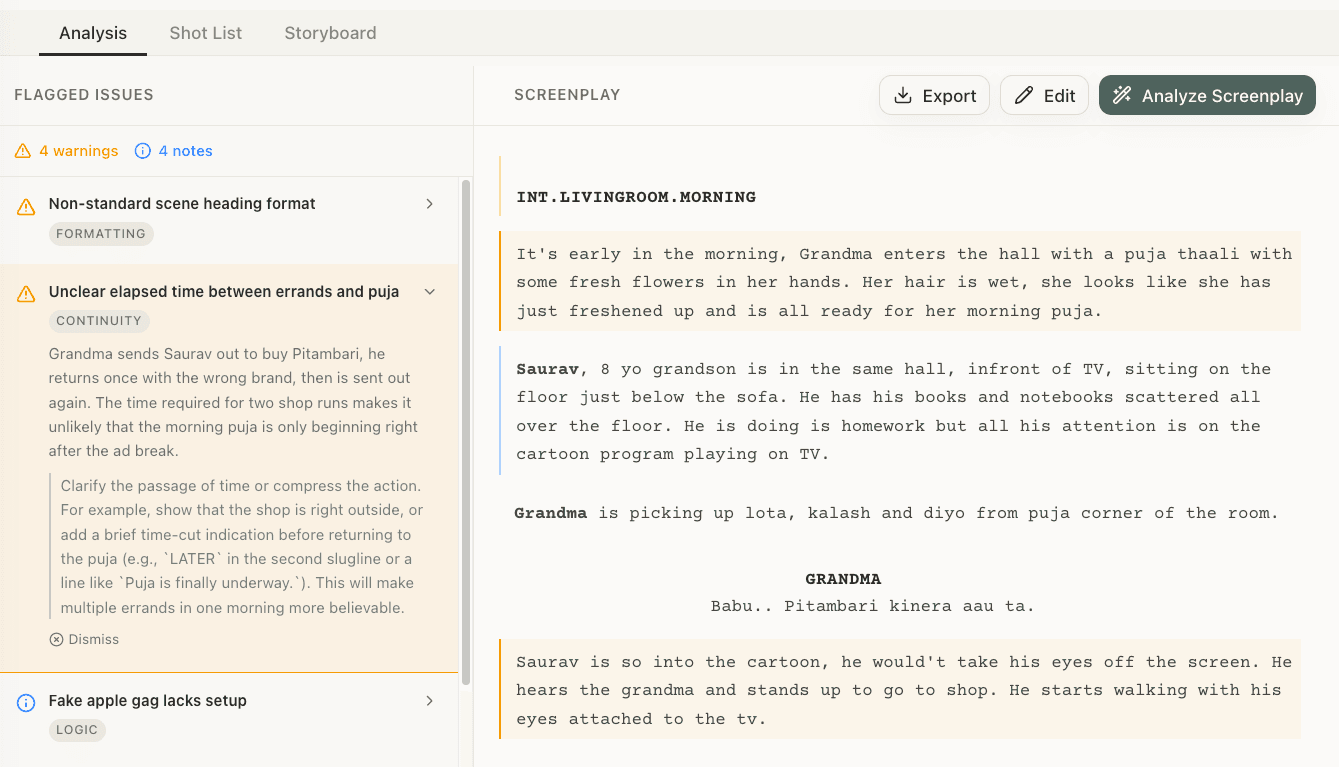
Not flagging script issues. The breakdown is your chance to identify plot holes, continuity problems, and logistical impossibilities while they're still cheap to fix. If something doesn't add up, now is the time to raise it with the writer.
Doing it alone. The best breakdowns involve the director, AD, production designer, and DP reviewing the script together. I always learn something from the production designer's read of a scene that I missed in my own.
Digital vs. Paper Breakdowns
Traditional breakdowns used printed scripts and physical highlighting. Modern workflows use digital tools that let you:
- Tag elements and automatically generate reports
- Track continuity across scenes
- Share breakdowns with your team in real time
- Connect the breakdown directly to your shot list and storyboard
The workflow is increasingly: screenplay upload → AI-assisted analysis → human review and refinement → shot list generation → storyboard creation. Each step builds on the previous one, and digital tools keep everything connected.
Summary
The breakdown is methodical work, but it pays for itself many times over. The key steps:
- Read the full script first (no marking)
- Number your scenes
- Analyze scene headers
- Tag production elements with consistent color-coding
- Check for continuity issues across scenes
- Create scene breakdown sheets
- Add your director's notes for shot planning
Ready to speed up your pre-production?
StoryBirdie turns your screenplay into a professional storyboard in minutes. See pricing or jump straight in.
About the author
Aayush is co-founder and director at StoryBirdie. He's a screenwriter, director, stand-up comedian, and full-stack developer — co-founder of Kathmandu's Comedy Tuk Tuk, with directing and writing credits on shorts, music videos, and comedy projects. He builds StoryBirdie on the conviction that storyboarding is expensive, time-consuming, and important — and that a tool for it should serve the filmmaker's vision, not replace it. StoryBirdie is currently in use on a Nepali feature, a Sri Lankan TV commercial, and at one of Nepal's largest production houses. Based in Kathmandu, Nepal.
Keep reading
- AI Screenplay Analysis: Catch Script Problems Before They Cost YouHow AI screenplay analysis tools catch continuity errors, blocking issues, and production problems that human reads miss. Save reshoot days.·8 min read
- Screenplay to Storyboard: A Director's WorkflowA director's guide to turning a screenplay into a storyboard. Covers script analysis, shot lists, frame planning, and AI tools.·14 min read
- Script Continuity Errors: How to Catch Them EarlyCatch script continuity errors before they cost you on set. Covers temporal, spatial, character, and prop continuity with examples.·14 min read
- Storyboard vs Animatic: What's the Difference?Storyboards and animatics serve different purposes in pre-production. Learn when to use each and how they work together.·10 min read