Dialogue Is the Hardest Thing to Storyboard Well
Action scenes have obvious visual beats — punches, explosions, chases. You know what the camera needs to see. Dialogue scenes are trickier because the visual decisions are subtler and the stakes are higher.
Get it wrong and the scene feels flat — talking heads bouncing back and forth like a tennis match. Get it right and the camera becomes an invisible storyteller, guiding the audience's attention, building tension, and revealing character through framing alone.
Most film school guidance on dialogue storyboarding begins and ends with "shot/reverse-shot." That's a starting point, not a strategy. Here's how to think about dialogue coverage at a deeper level.
The Three Coverage Decisions
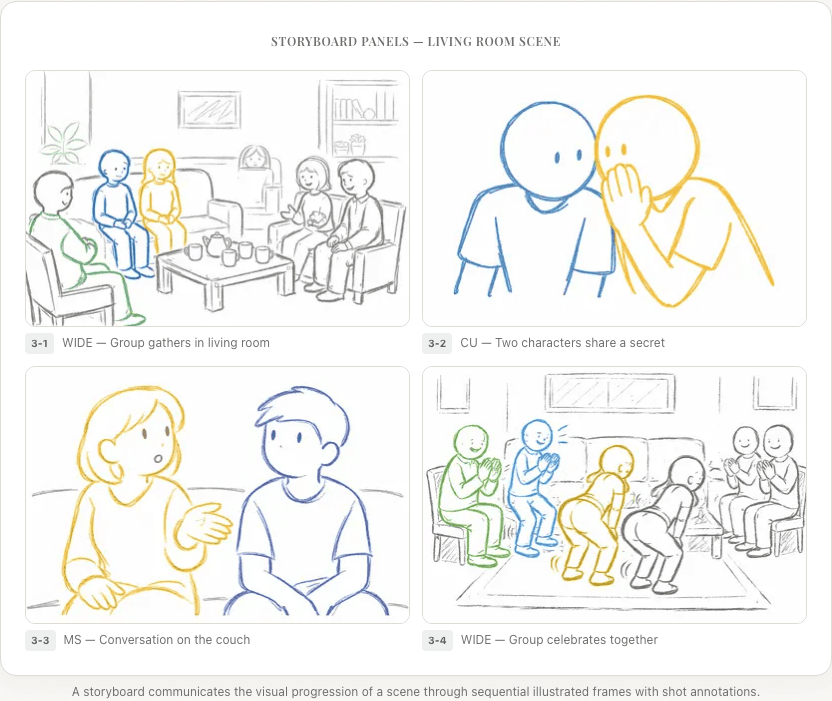
Before you draw a single frame, make three decisions about the scene:
1. Who Has Power?
Every dialogue scene has a power dynamic. Even a casual conversation between equals shifts moment to moment — one person is more confident, more informed, or more emotionally invested than the other.
Your camera should reflect this:
| Power Dynamic | Camera Approach |
|---|---|
| Character A dominates | Slight low angle on A, slight high on B |
| Equal exchange | Eye-level on both |
| Power shifts mid-scene | Start with one setup, shift angles at the turning point |
| Power is ambiguous | Use framing (negative space, blocking) instead of angle |
Watch any well-directed dialogue scene and you'll notice: the camera angle shifts at the emotional turning points. The shift itself tells the audience something just changed — even before the dialogue confirms it.
2. What's the Emotional Distance?
Shot size controls how close the audience feels to the characters. A wide two-shot says "observe these people." A tight close-up says "feel what this person feels."
The progression principle: Most well-covered dialogue scenes move from wider to tighter as emotional intensity increases. Start with an establishing two-shot, move to medium singles for the exchange, then close-ups for the emotional climax.
This isn't a rule — it's a pattern that works because it mirrors how humans naturally pay attention. When a conversation gets intense, we lean in. The camera should do the same.
3. When Should the Camera Cut vs. Hold?
Fast cutting creates energy but can feel restless. Long holds create tension but can feel slow. The cutting rhythm should match the scene's emotional rhythm.
Fast cutting works for: Arguments, rapid-fire wit, escalating tension, comedy timing Long holds work for: Revelations, emotional processing, uncomfortable silence, building dread
The Standard Coverage Pattern (And When to Break It)
The baseline for dialogue coverage is:
- Master shot (wide two-shot) — establishes spatial relationship
- Single on Character A — usually over-the-shoulder from B's side
- Single on Character B — reverse OTS from A's side
- Insert shots — props, hands, environment details as needed
This gives your editor everything they need: context (master), performance (singles), and texture (inserts). It's the coverage pattern used in the majority of Hollywood dialogue scenes.
When to break it:
Oners (unbroken takes): When the blocking IS the story — characters moving through space, the physical relationship changing. Robert Altman, Alfonso Cuaron, and Sam Mendes use oners for dialogue that's about spatial power, not just verbal exchange.
Dirty singles instead of clean OTS: Keep the other character's shoulder or profile in frame for connection. Remove it (clean single) for isolation. The choice communicates whether a character is engaged with or cut off from the other.
Off-screen dialogue: Sometimes the most powerful choice is to stay on the listener while the speaker talks. The reaction tells us more than the delivery. Hitchcock did this constantly — holding on the face processing information while the voice provides it.
Storyboarding the Five-Beat Dialogue Scene
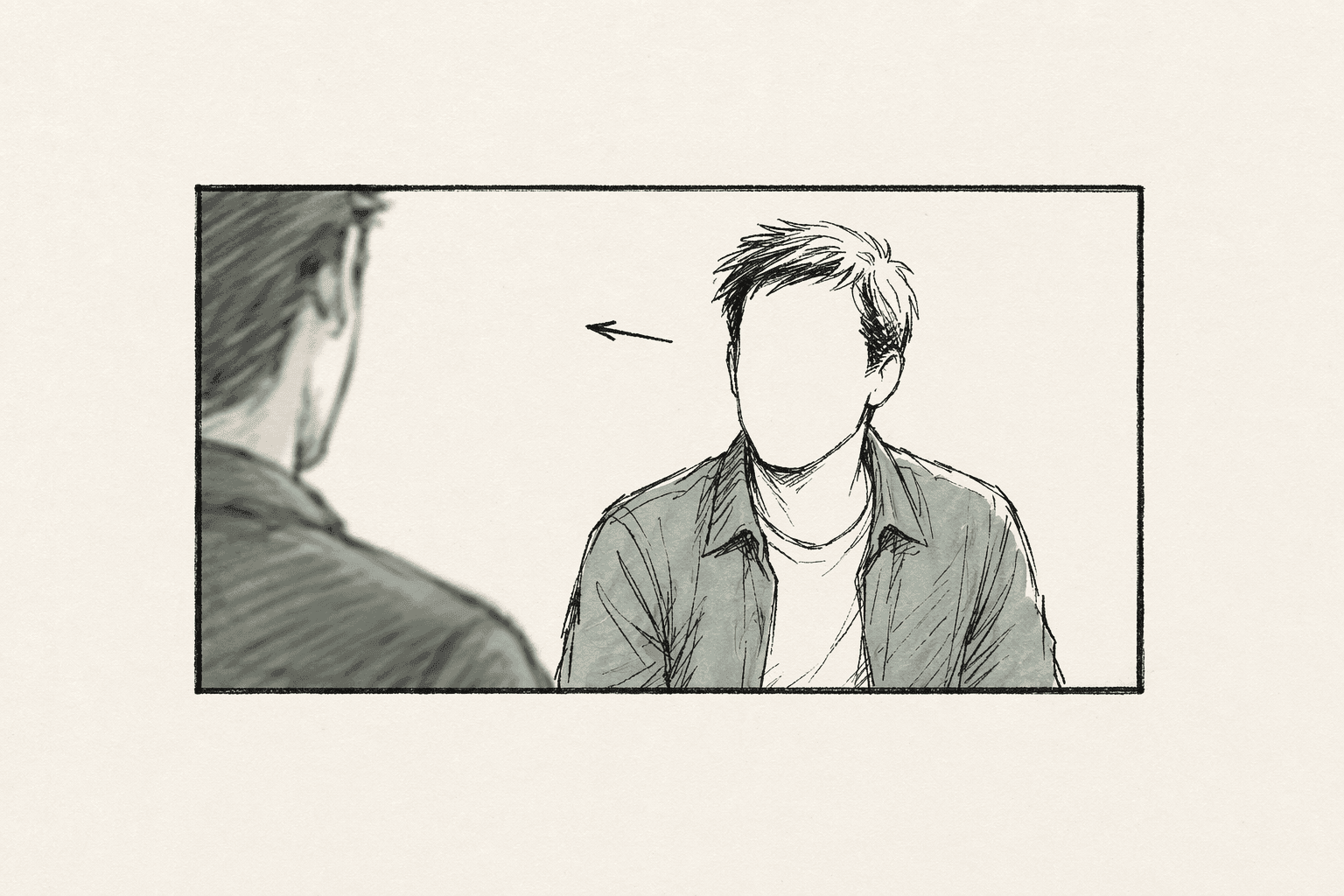
Here's a practical template for a standard dramatic dialogue scene. Most conversations follow this rhythm:
Beat 1: Entry and Establishment (2-3 frames)
Frame 1: Wide establishing shot. Both characters in the space. The audience needs to understand the geography: where are they, how far apart, what's between them.
Frame 2: Transition to the first speaking character. Medium shot or medium close-up, depending on the scene's starting intensity.
Storyboard notes: Mark character positions, sight lines, and any environmental elements that will matter later (a door someone will exit through, a table someone will slam).
Beat 2: The Exchange (4-6 frames)
The main dialogue exchange. Standard coverage: alternating singles, with occasional returns to the two-shot to re-establish spatial relationship.
Frame 3-4: Shot/reverse-shot on each character. Match the shot sizes — if A is in a medium close-up, B should be too. Mismatched sizes create subconscious bias.
Frame 5: Return to two-shot when a new piece of information enters the scene (a revelation, an interruption, a physical action).
Storyboard notes: Mark which lines of dialogue each shot covers. Your editor will thank you.
Beat 3: The Turn (1-2 frames)
Every good dialogue scene has a turn — the moment where the power shifts, new information arrives, or the emotional temperature changes.
Frame 6: This is your hero frame. The camera should DO something different here: push in, change angle, shift from OTS to clean single, or break the established pattern. The visual shift tells the audience "pay attention — something just changed."
Beat 4: The Aftermath (2-3 frames)
The reaction to the turn. Often the most important shots in the scene.
Frame 7-8: Close-ups on reaction. Hold longer than feels comfortable. The audience needs time to process along with the character.
Beat 5: Resolution or Exit (1-2 frames)
Frame 9: Pull back to wider framing for resolution (re-establishing distance), or push even tighter for an unresolved ending. The final shot size tells the audience whether the characters have reconnected or split further apart.
Total: 9-12 storyboard frames for a typical dialogue scene. That's manageable. You don't need 30 frames — you need the right 9. (For more on panel count by scene type, see how many storyboard panels per scene.)
Common Dialogue Storyboarding Mistakes
The tennis match. Cutting back and forth at identical sizes and angles for every line. This is technically correct coverage but emotionally dead. Vary your sizes, angles, or timing to create rhythm.
Forgetting the listener. Storyboarding only the speaker's shots. In most dialogue scenes, the listener's reaction is as important as the speaker's delivery. Board the reaction shots.
Ignoring blocking. Two characters sitting across a table is the most boring blocking in cinema. (For how to analyze and plan blocking from your script, see screenplay breakdown.) If possible, give characters reasons to move — pour a drink, look out a window, pace. Movement creates visual interest and gives you natural motivation for camera repositioning.
Over-cutting. Not every line needs its own shot. Sometimes staying on one character while the other speaks off-screen is more powerful than cutting to the speaker. Over-cutting dilutes the most important moments.
No plan for silence. The pauses between lines are often where the real drama lives. Board the moments between dialogue, not just the dialogue itself.
Frequently Asked Questions
Ready to speed up your pre-production?
StoryBirdie turns your screenplay into a professional storyboard in minutes. See pricing or jump straight in.
About the author
Aayush is co-founder and director at StoryBirdie. He's a screenwriter, director, stand-up comedian, and full-stack developer — co-founder of Kathmandu's Comedy Tuk Tuk, with directing and writing credits on shorts, music videos, and comedy projects. He builds StoryBirdie on the conviction that storyboarding is expensive, time-consuming, and important — and that a tool for it should serve the filmmaker's vision, not replace it. StoryBirdie is currently in use on a Nepali feature, a Sri Lankan TV commercial, and at one of Nepal's largest production houses. Based in Kathmandu, Nepal.
Keep reading
- How to Storyboard a Fight SceneStoryboard fight scenes that are clear, impactful, and editable. Covers choreography beats, camera placement, and cutting rhythm for action.·8 min read
- How to Storyboard a Commercial: A Director's WorkflowStoryboarding a commercial: timing, product shots, client-approval drafts, and the agency workflow that keeps clients and crew aligned.·8 min read
- How to Storyboard a Music VideoA practical guide to storyboarding music videos. Covers beat mapping, visual rhythm, performance vs narrative, and tools for MV directors.·8 min read
- How to Storyboard a Short Film: Step by StepA practical, step-by-step guide to storyboarding your short film. Covers what to storyboard, what to skip, and how to create boards that actually help on set.·8 min read