Camera Angles Aren't Technical Decisions — They're Storytelling Decisions
Every camera angle changes how the audience experiences a moment. A low angle looking up at a character makes them feel powerful. The same character from a high angle feels small and vulnerable. The content of the scene hasn't changed. What changed is how the audience feels about it.
New directors often choose angles based on what "looks cool." Experienced directors choose angles based on what the story needs the audience to feel. That's the difference between a technically competent film and one that moves people.
This guide covers every major camera angle with a simple framework: what it looks like, what it makes the audience feel, and when to use it.
Eye Level
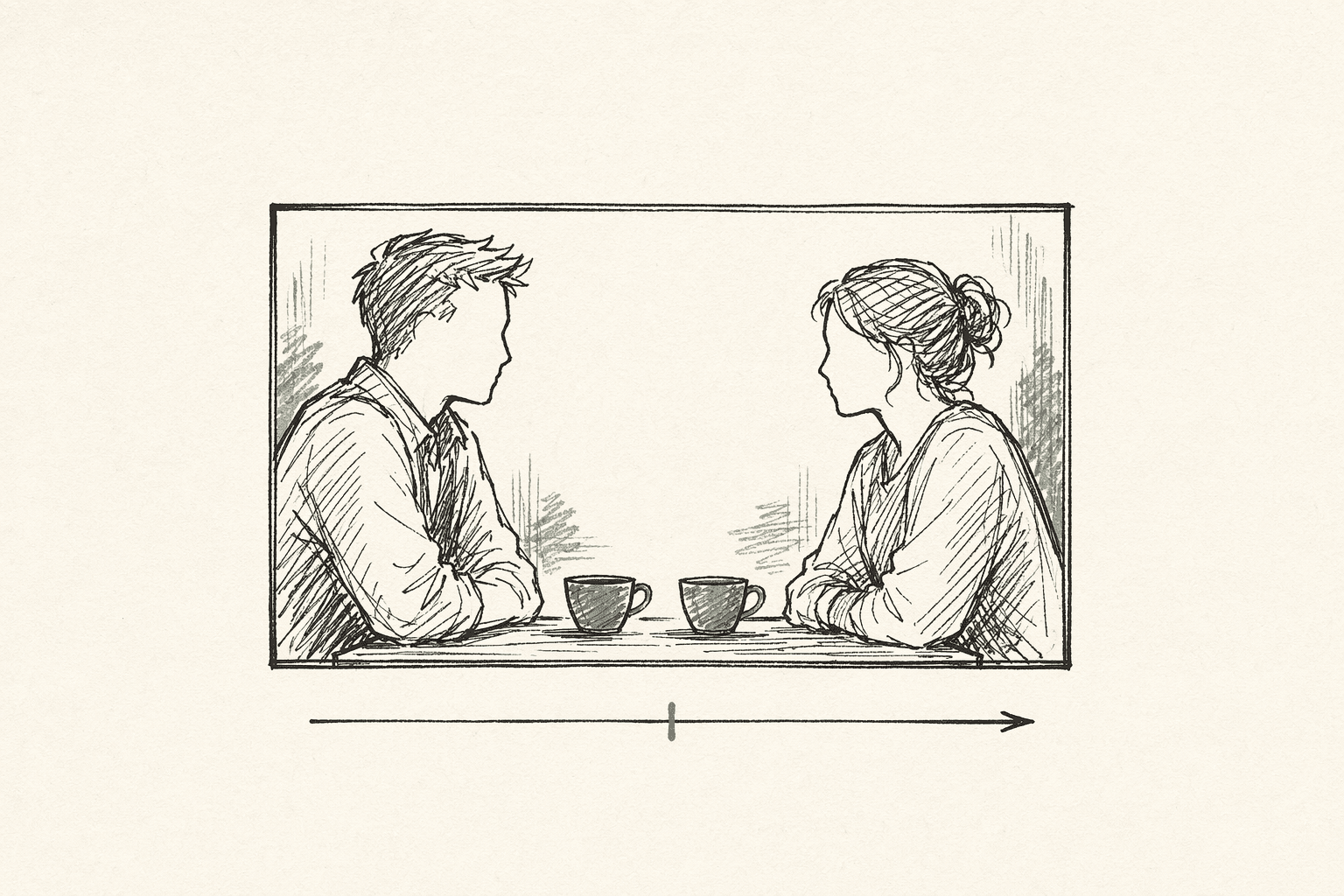
What it looks like: Camera at the character's eye height. The most neutral angle.
What the audience feels: Equality. They're looking at the character as an equal — not above them, not below them. It's observational, unbiased.
When to use it: Dialogue scenes where you don't want the camera to editorialize. Conversations between characters of equal power. Documentary-style sequences. Any moment where you want the audience to observe without the camera influencing their perception.
When to avoid it: When you want to convey power dynamics. Eye level flattens hierarchies. If one character dominates another, eye level won't show it.
Director's note: Eye level is the default. If you don't have a specific reason for a different angle, eye level is almost always the right choice. Breaking from eye level should be deliberate, not arbitrary.
Low Angle
What it looks like: Camera below eye level, angled upward at the subject.
What the audience feels: Power, authority, dominance, menace. The character looms. They look bigger, more imposing. The audience is positioned beneath them — literally looking up.
When to use it:
- Establishing a character's authority or threat
- The moment a character takes control of a situation
- Villains — low angles are a classic villain introduction tool
- Heroes at their strongest moments
- Tall structures, vast spaces (emphasizes scale)
When to avoid it: When a character is meant to feel vulnerable, uncertain, or diminished. Low angles on a nervous character create cognitive dissonance — the camera says "powerful" while the performance says "scared."
Classic example: Orson Welles in Citizen Kane. The low angles on Kane aren't about aesthetics — they're about power. As Kane gains and loses power through the film, the camera angle shifts with him.
High Angle
What it looks like: Camera above eye level, angled downward.
What the audience feels: Vulnerability, smallness, being observed. The character looks diminished in the frame. The audience looks down on them — psychologically, not just physically.
When to use it:
- A character at their lowest point
- Showing someone trapped or overwhelmed
- Surveillance — the voyeuristic quality of looking down on someone
- Establishing geography (showing the layout of a space from above)
- Emotional isolation — a character small in a large space
When to avoid it: When you want a character to feel strong or in control. The high angle undercuts authority.
Classic example: The final shot of The Shawshank Redemption — the overhead crane shot of Andy in the rain. But this breaks the convention: the high angle here doesn't diminish Andy. It liberates him. The space opening up above him represents freedom. Rules exist to be broken — but you have to know the rule first.
Dutch Angle (Canted/Tilted)
What it looks like: Camera tilted on its roll axis, so the horizon is no longer level.
What the audience feels: Unease, disorientation, something wrong. The world is literally off-kilter.
When to use it:
- Psychological instability (a character losing grip on reality)
- Horror and thriller tension beats
- Drug/alcohol altered states
- The moment something changes irreversibly (the world tilting)
When to avoid it: Casual use. The dutch angle is one of the most overused techniques in student films. If it doesn't serve a specific narrative purpose, it just looks like the tripod was broken. Use sparingly. When you use it, commit — a subtle tilt reads as a mistake; a decisive tilt reads as intentional.
Classic example: The Third Man (1949). Carol Reed used dutch angles throughout to create a persistent sense that Vienna's post-war world was morally crooked. The tilt isn't an effect — it's a thesis statement.
Bird's Eye / Overhead
What it looks like: Camera directly above the subject, looking straight down.
What the audience feels: God's-eye omniscience. Total removal from the human perspective. The subject becomes an element in a pattern rather than a person in a scene.
When to use it:
- Establishing the geography of a complex space
- Dance or choreography (showing the pattern from above)
- A character's isolation (small figure in vast space)
- Transitional moments (scene changes, time shifts)
- Crime scenes, maps, documents (showing the audience key information)
When to avoid it: Intimate character moments. The overhead angle removes empathy because we lose facial expression and eye contact. Don't use it during emotional dialogue.
Classic example: The blood-thin-line sequence in There Will Be Blood — the overhead shot of the oil derrick. The human figures are dwarfed by the machinery. That's the point.
Over-the-Shoulder (OTS)
What it looks like: Camera positioned behind one character's shoulder, looking at the other character's face.
What the audience feels: Connection between two characters. The audience is placed in the conversation, seeing one character from the other's approximate perspective. It creates spatial relationship without full point-of-view.
When to use it:
- Dialogue scenes (the workhorse angle for conversation)
- Confrontations (the shoulder in foreground creates tension)
- Interview setups
- Any two-person exchange where spatial relationship matters
When to avoid it: When you want to isolate a character. OTS always implies connection — the other person's presence is felt even when blurred in foreground. If a character is emotionally alone in a scene, a clean single (no shoulder in frame) communicates that better.
Point of View (POV)
What it looks like: Camera positioned where the character's eyes would be. The audience sees exactly what the character sees.
What the audience feels: Total identification. The audience is the character for the duration of the shot. Maximum empathy (or maximum discomfort, if the POV belongs to a threatening figure).
When to use it:
- Key revelations (the audience discovers something simultaneously with the character)
- Horror (the victim's POV as the threat approaches)
- Suspense (seeing through the stalker's eyes)
- Physical experiences (driving, running, falling)
When to avoid it: Extended sequences. Full POV gets exhausting fast — the audience wants to see the character's face to read their reaction. Use POV for beats, not scenes. The reveal, the shock, the key moment — then cut back to a more standard angle.
Choosing Angles for Your Storyboard
When building your shot list and storyboard, run each shot through this framework:
1. What does the audience need to feel in this moment? The angle is the tool. The emotion is the goal.
2. What's the character's power in this moment? Rising power → consider lower angles. Falling power → consider higher angles. Stable → eye level.
3. Does this angle change from the previous shot? Angle shifts create emphasis. If you've been at eye level for 30 seconds and suddenly drop to a low angle, the audience registers the change subconsciously. Use shifts intentionally.
4. Does this break the rules for a reason? Breaking conventions works when it's purposeful. A high angle on a powerful character can create irony (the audience sees their power as illusory). A low angle on a vulnerable character can show their hidden strength. Know the rule. Then break it deliberately.
Ready to speed up your pre-production?
StoryBirdie turns your screenplay into a professional storyboard in minutes. See pricing or jump straight in.
About the author
Aayush is co-founder and director at StoryBirdie. He's a screenwriter, director, stand-up comedian, and full-stack developer — co-founder of Kathmandu's Comedy Tuk Tuk, with directing and writing credits on shorts, music videos, and comedy projects. He builds StoryBirdie on the conviction that storyboarding is expensive, time-consuming, and important — and that a tool for it should serve the filmmaker's vision, not replace it. StoryBirdie is currently in use on a Nepali feature, a Sri Lankan TV commercial, and at one of Nepal's largest production houses. Based in Kathmandu, Nepal.
Keep reading
- How to Create a Shot List: A Director's GuideLearn how to create a shot list step by step. Covers shot types, camera angles, movement notation, and scene organization.·14 min read
- How to Storyboard for Animation: A Step-by-Step GuideStoryboarding for animation, step by step: timing, staging, acting through drawing, and the animatic pipeline. With real examples directors use.·8 min read
- How to Storyboard a Commercial: A Director's WorkflowStoryboarding a commercial: timing, product shots, client-approval drafts, and the agency workflow that keeps clients and crew aligned.·8 min read
- How to Storyboard a Dialogue SceneCamera angles, shot sizes, and pacing strategies for storyboarding dialogue. Practical coverage patterns every director should know.·8 min read