The Short Answer: 8-15 Panels for Most Scenes
For a standard 2-3 page dialogue scene, you need 8-15 storyboard panels. For an action sequence, 20-40. For VFX-heavy scenes, every single shot should be boarded.
But "it depends" isn't helpful when you're staring at a blank page trying to figure out how much work is ahead of you. Here's a practical formula that gives you a real number.
The Formula
Storyboard panels = number of shots × 0.7
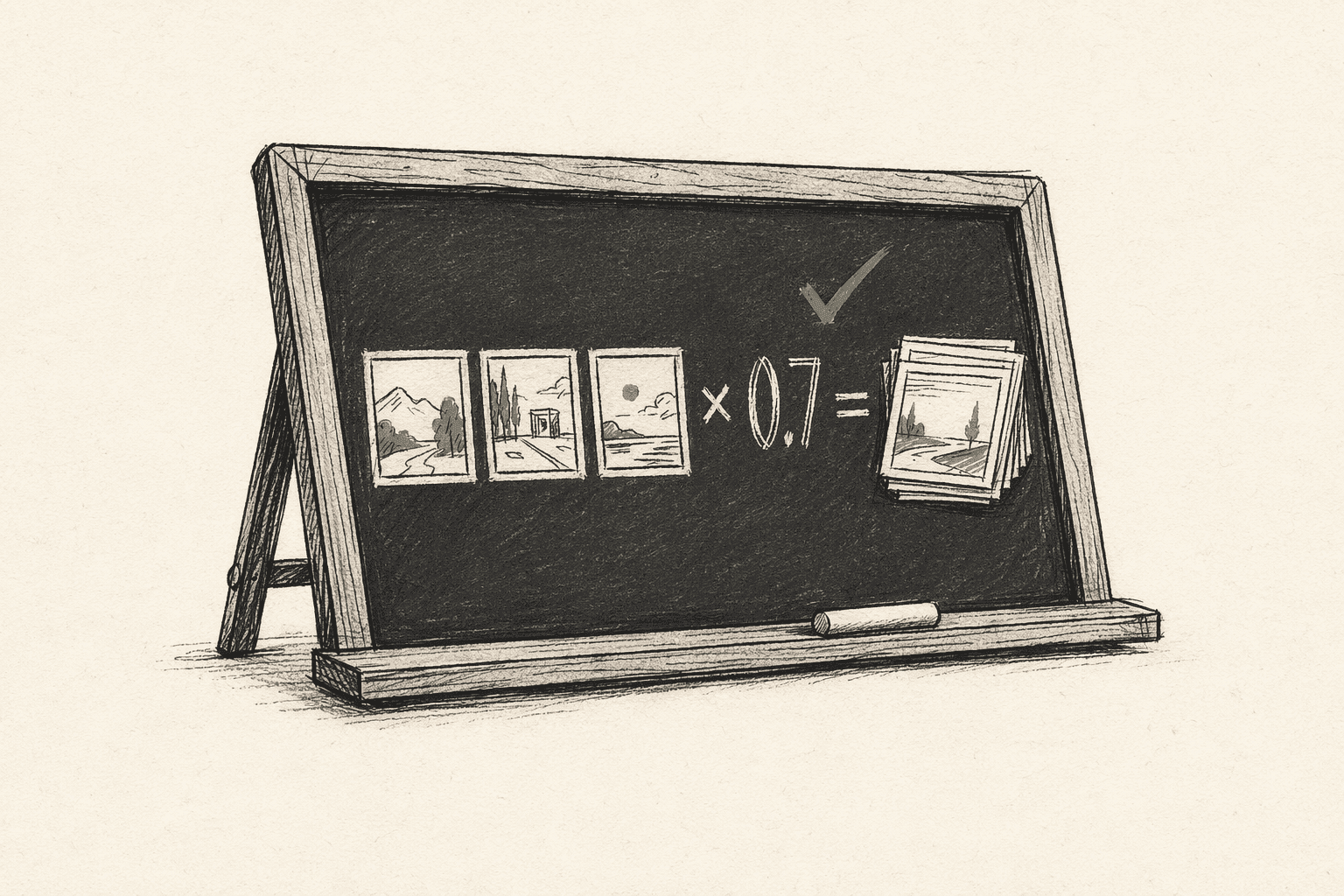
Not every shot needs its own storyboard panel. Standard coverage shots (basic OTS dialogue, simple establishing wides) can be implied by a note rather than drawn. The 0.7 multiplier accounts for this.
To estimate shot count:
| Scene Type | Shots per Page of Script | Panels per Page |
|---|---|---|
| Dialogue (standard coverage) | 8-12 shots | 6-9 panels |
| Dialogue (stylized/oners) | 3-6 shots | 3-5 panels |
| Action/fight | 15-25 shots | 12-20 panels |
| Chase sequence | 20-30 shots | 15-22 panels |
| VFX/green screen | 10-15 shots | 10-15 panels (board all) |
| Montage | 8-12 shots | 6-10 panels |
| Quiet/atmospheric | 4-8 shots | 3-6 panels |
Example: A 3-page dialogue scene with standard coverage = 3 pages × 10 shots/page × 0.7 = ~21 panels. In practice, 15-20 panels covers it well.
A 1-page fight scene = 1 page × 20 shots × 0.7 = ~14 panels. But because fight choreography needs more visual clarity, you'd board closer to 18-20.
What Drives Panel Count Up
Complex blocking. More characters moving through space = more panels to show positions and transitions.
Camera movement. A dolly move needs at least two panels — start position and end position. A complex tracking shot might need 3-4 panels showing key moments along the movement.
Emotional beats. Close-up reaction shots at key dramatic moments deserve their own panels. These are your "hero frames" — the images that define the scene's visual identity.
VFX elements. Every shot with visual effects should be boarded. VFX artists work from storyboards, and changes after compositing are expensive. An unbounded VFX shot is a budget risk.
New information. Any moment where the audience learns something new (a reveal, a discovery, a plot turn) warrants its own panel. The composition of that frame communicates how the audience should receive the information.
What Drives Panel Count Down
Standard coverage patterns. If a dialogue scene uses conventional shot/reverse-shot, you don't need to board every single reverse angle. Board the master, one representative single on each character, and any deviation from the pattern.
Repeated setups. If you're cutting between two characters at the same angles for 10 lines of dialogue, board the setup once and note "continues for lines 5-15."
Simple scenes. A character walks into a room and sits down. One or two panels covers it unless the blocking is unusually complex.
Experience with your DP. If you've worked with your cinematographer before and share a visual vocabulary, you need fewer panels because they can fill in the gaps. First-time collaborations need more visual specificity.
Panel Count by Project Type
Short Film (10-15 minutes, 20-30 scenes)
Don't storyboard every scene. Board the 8-10 most visually demanding scenes. The rest get shot lists.
Total panels for a well-boarded short film: 80-150 panels
Time investment: 8-15 hours of storyboarding (manual) or 2-4 hours (AI-assisted)
Feature Film (90-120 minutes, 60-100 scenes)
Even Ridley Scott doesn't draw 2,000 panels for a feature. Board the key sequences — maybe 30-40% of scenes get full storyboards, the rest get shot lists or brief visual notes.
Total panels for a well-boarded feature: 300-600 panels for key sequences
Commercial (:30 spot, 10-15 shots)
Board every shot. Commercials have no room for improvisation — every second is accounted for.
Total panels: 10-15 panels for a :30, 20-30 for a :60
Music Video (3-4 minutes, 40-60 shots)
Board the hero moments — opening, first chorus, bridge, closing. Shot-list the performance coverage.
Total panels: 15-25 panels for key moments
The "Board Only What Needs Visual Planning" Rule
Here's the filter that experienced directors use: if you can describe the shot in one sentence and your DP will understand it, you don't need a panel. If the shot requires visual explanation, board it.
Shots that need panels:
- Complex compositions with specific element placement
- Camera movements coordinated with blocking
- Shots where framing carries emotional meaning
- VFX and green screen compositions
- Anything unusual or unconventional
Shots that don't need panels:
- Standard OTS coverage at eye level
- Basic establishing wides of familiar locations
- Reaction shots (unless the reaction IS the scene)
- Simple inserts (close-up of a phone screen, a clock)
This filter typically cuts your panel count by 30-40% without losing any meaningful visual communication.
Frequently Asked Questions
Ready to speed up your pre-production?
StoryBirdie turns your screenplay into a professional storyboard in minutes. See pricing or jump straight in.
About the author
Aayush is co-founder and director at StoryBirdie. He's a screenwriter, director, stand-up comedian, and full-stack developer — co-founder of Kathmandu's Comedy Tuk Tuk, with directing and writing credits on shorts, music videos, and comedy projects. He builds StoryBirdie on the conviction that storyboarding is expensive, time-consuming, and important — and that a tool for it should serve the filmmaker's vision, not replace it. StoryBirdie is currently in use on a Nepali feature, a Sri Lankan TV commercial, and at one of Nepal's largest production houses. Based in Kathmandu, Nepal.
Keep reading
- How to Storyboard a Film: The Complete GuideLearn how to storyboard a film from start to finish. Covers frame composition, shot notation, formats, and modern workflows.·15 min read
- VFX Storyboarding: A Director's GuideHow to storyboard VFX-heavy scenes. Covers pre-viz requirements, green screen planning, and communicating with your VFX team.·9 min read
- How to Storyboard a Dialogue SceneCamera angles, shot sizes, and pacing strategies for storyboarding dialogue. Practical coverage patterns every director should know.·8 min read
- How to Storyboard a Fight SceneStoryboard fight scenes that are clear, impactful, and editable. Covers choreography beats, camera placement, and cutting rhythm for action.·8 min read