Fight Scenes Are Edited in Pre-Production
The difference between a fight scene that feels visceral and one that feels chaotic is almost never the choreography. It's the camera coverage and editing rhythm — and both of those are determined in the storyboard.
A well-storyboarded fight tells the audience exactly what's happening at every moment: who's winning, who's losing, where each character is in the space, and what's at stake. A poorly storyboarded fight is a blur of motion cuts that the audience endures rather than follows.
Action directors like Chad Stahelski (John Wick), George Miller (Mad Max: Fury Road), and David Leitch (Atomic Blonde) storyboard their fights obsessively — sometimes drawing 200+ frames for a single 90-second sequence. You don't need 200 frames. But you do need to board every beat that matters.
Step 1: Break the Fight Into Beats
Before you think about camera angles, break the choreography into dramatic beats. A fight scene is a story with its own three-act structure:
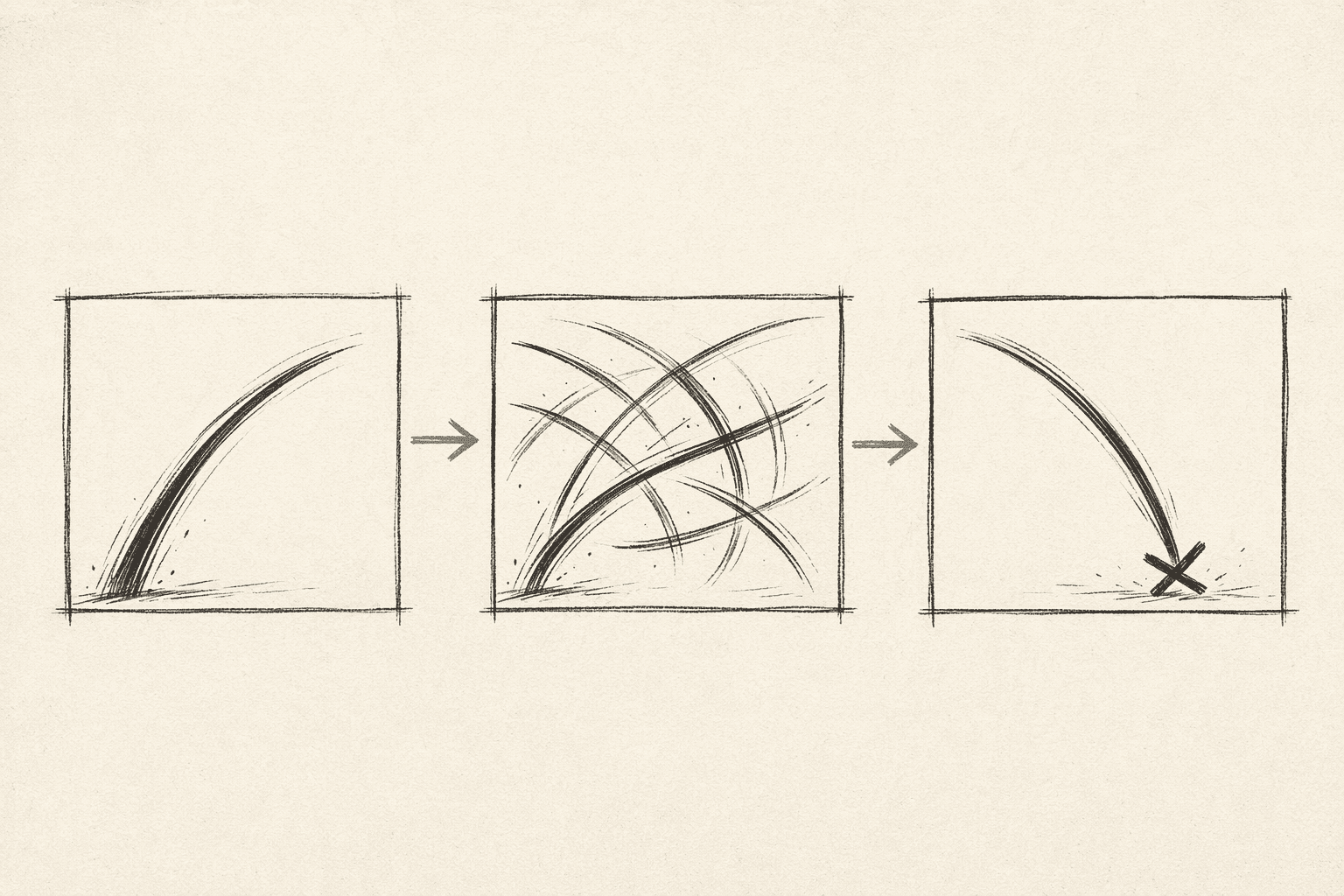
Act 1: Initiation — How does the fight start? Who throws the first punch? Is there a buildup or is it sudden?
Act 2: Exchange — The main combat. This is where the power dynamic shifts. Mark the moments where one fighter gains or loses advantage.
Act 3: Resolution — How does it end? Knockout? Submission? Interruption? Escape?
Within each act, identify the key moments — not every punch, but the punches that matter:
| Beat Type | Example | Why It Matters |
|---|---|---|
| Power shift | Fighter A takes a hit, stumbles | The audience's rooting interest changes |
| Weapon/environment use | Fighter grabs a chair, slams into a wall | Raises stakes, uses the space |
| Near-miss | A blade barely misses, a punch narrowly dodged | Maximum tension |
| Signature move | The technique we've been set up to expect | Payoff of earlier setup |
| Turning point | The underdog finds their footing | Emotional climax of the fight |
You're storyboarding these beats, not every jab and block.
Step 2: Map the Geography
Fight storyboards fail when the audience loses track of where the characters are. Before drawing frames:
Create an overhead diagram of the fight space. Mark:
- Starting positions of each fighter
- Movement paths during the fight
- Environmental obstacles (furniture, walls, stairs, vehicles)
- Key positions where major beats happen
Establish and maintain screen direction. (Understanding camera angles is essential here.) If Fighter A is attacking from screen-left in shot 1, they should stay screen-left throughout the sequence (or cross the line deliberately with a specific bridging shot). Breaking screen direction without purpose makes fights incomprehensible.
The John Wick franchise maintains screen direction obsessively — in the Red Circle nightclub fight (77 shots, 128 seconds), by one analysis, screen direction is consistent in 94% of consecutive shot pairs.
Step 3: Choose Your Coverage Strategy
Three approaches, each suited to different fight styles:
Wide and Long (The Jackie Chan Approach)
Camera: Wide to medium shots, minimal cutting. Let the choreography play out in real time.
Best for: Martial arts, dance-like combat, fights where physical skill is the spectacle.
Storyboard approach: Fewer frames, longer duration per frame. Board the key composition and let the fighters move within it. Note camera repositioning between setups but don't over-cut.
Jackie Chan's fight sequences tend to average around 3-5 seconds per shot — well above the Hollywood average — giving the audience time to appreciate the choreography.
Fast and Close (The Paul Greengrass Approach)
Camera: Tight close-ups, rapid cutting, handheld movement. Creates chaos and visceral impact.
Best for: Street fights, survival combat, fights where the experience of being in the fight matters more than seeing the technique.
Storyboard approach: Many frames, short duration each. Board the impact moments — fist connecting, body hitting ground, face reacting to pain. The connecting choreography lives between frames.
Average shot length in Bourne fight sequences is often under 1.5 seconds.
Hybrid (The Chad Stahelski Approach)
Camera: Alternates between wide coverage for technique and close-ups for impact. Uses oners for extended sequences with strategic cuts for emphasis.
Best for: Most modern action. Lets the audience appreciate the choreography while feeling the impacts.
Storyboard approach: Board the wide oner sections as single frames with movement arrows. Board the close-up impact beats as individual frames. Note where the editor should cut between styles.
Step 4: Board the Key Frames
For a 30-second fight sequence, you need approximately 15-25 storyboard frames. Here's the allocation:
Initiation (3-4 frames)
- Frame 1: Pre-fight tension. Both characters in frame, the moment before violence.
- Frame 2: The first strike. Show who initiates and how.
- Frame 3: The reaction. Physical impact of the first strike.
Exchange (8-12 frames)
Board only the beats that shift the fight's dynamic:
- Each power shift gets a frame (or two — the hit and the reaction)
- Environmental interactions get frames (crashing through a table, grabbing a weapon)
- Near-misses get frames (these are your tension peaks)
Between-beat choreography (the jab-jab-block-counter patterns) can be indicated in notes: "4-5 exchanges of close-quarters striking, A slightly dominant." Your stunt coordinator will fill in the specifics.
Resolution (3-4 frames)
- The decisive moment: The final blow, submission, or escape.
- The aftermath: The winner standing over the loser, the escape route, the consequence.
- The transition out: How does the scene move on from the fight?
Step 5: Annotate for Your Stunt Team
Fight storyboards need annotations that standard dramatic storyboards don't:
Speed notes: "Slow motion from beat 4-5" or "Ramp from 24fps to 96fps on the kick."
Impact notes: Mark which hits connect and which are near-misses. Your stunt team needs to know which moments require contact and which are camera-angle sells.
Safety notes: Mark any stunts that require wire rigs, crash pads, or specific safety measures. The storyboard is your communication tool with your stunt coordinator.
Prop notes: Breakaway furniture, rubber weapons, blood hits. Each impact that uses practical effects needs a storyboard callout.
Common Fight Scene Storyboarding Mistakes
Boarding every hit. A 30-second fight might have 40 individual strikes. You don't need 40 frames. Board the 15-20 beats that matter — the hits that change the power dynamic, not the routine exchange.
Forgetting the geography. If the audience can't tell where the fighters are relative to each other and the space, the fight fails. Include establishing wide shots at the start and after any major repositioning.
Inconsistent screen direction. Fighter A attacks from the left in shot 1 and from the right in shot 3 with no bridging shot. This confuses the audience about who's hitting whom. Maintain consistent screen direction or use a clear crossing shot.
No breathing room. The most effective fight scenes have pauses — moments where both fighters catch their breath, reassess, or the stakes escalate through dialogue or environment. Board these pauses. They're where the audience processes what just happened and builds anticipation for what's next.
Identical shot sizes throughout. If every frame is a medium shot, the fight feels monotonous. (See shot list creation for more on varying shot sizes.) Vary between wides (geography), mediums (choreography), and close-ups (impact and emotion). The size changes create visual rhythm.
Frequently Asked Questions
Ready to speed up your pre-production?
StoryBirdie turns your screenplay into a professional storyboard in minutes. See pricing or jump straight in.
About the author
Aayush is co-founder and director at StoryBirdie. He's a screenwriter, director, stand-up comedian, and full-stack developer — co-founder of Kathmandu's Comedy Tuk Tuk, with directing and writing credits on shorts, music videos, and comedy projects. He builds StoryBirdie on the conviction that storyboarding is expensive, time-consuming, and important — and that a tool for it should serve the filmmaker's vision, not replace it. StoryBirdie is currently in use on a Nepali feature, a Sri Lankan TV commercial, and at one of Nepal's largest production houses. Based in Kathmandu, Nepal.
Keep reading
- How to Storyboard a Dialogue SceneCamera angles, shot sizes, and pacing strategies for storyboarding dialogue. Practical coverage patterns every director should know.·8 min read
- How to Storyboard a Commercial: A Director's WorkflowStoryboarding a commercial: timing, product shots, client-approval drafts, and the agency workflow that keeps clients and crew aligned.·8 min read
- How to Storyboard a Music VideoA practical guide to storyboarding music videos. Covers beat mapping, visual rhythm, performance vs narrative, and tools for MV directors.·8 min read
- How to Storyboard a Short Film: Step by StepA practical, step-by-step guide to storyboarding your short film. Covers what to storyboard, what to skip, and how to create boards that actually help on set.·8 min read