Pre-production is the part of the shoot where you can still change everything cheaply.
On set, every decision costs a setup. A blocked door becomes a 30-minute reshoot of the master. A wardrobe call you missed becomes a continuity gap nobody catches until the edit. The job of pre-production is to make those decisions in the calm — not under the clock with a crew waiting.
Most directors I know start pre-production thinking it's about logistics. It's not. It's about catching the questions you didn't know you had. Did you confirm the lighting plan for the night exterior? Did the costume designer get the wardrobe continuity from scene 14 to scene 32? Is the location locked, or is it "verbally agreed and the contract is coming"? These aren't logistics — they're the things that, if you don't catch them, will eat half a shoot day.
A checklist isn't comprehensive. The 1st AD's production breakdown is comprehensive. The line producer's budget is comprehensive. The shooting schedule is comprehensive. The checklist is the catch-all that surfaces the one thing nobody else noticed — because every other document is about volume, and this one is about decision points.
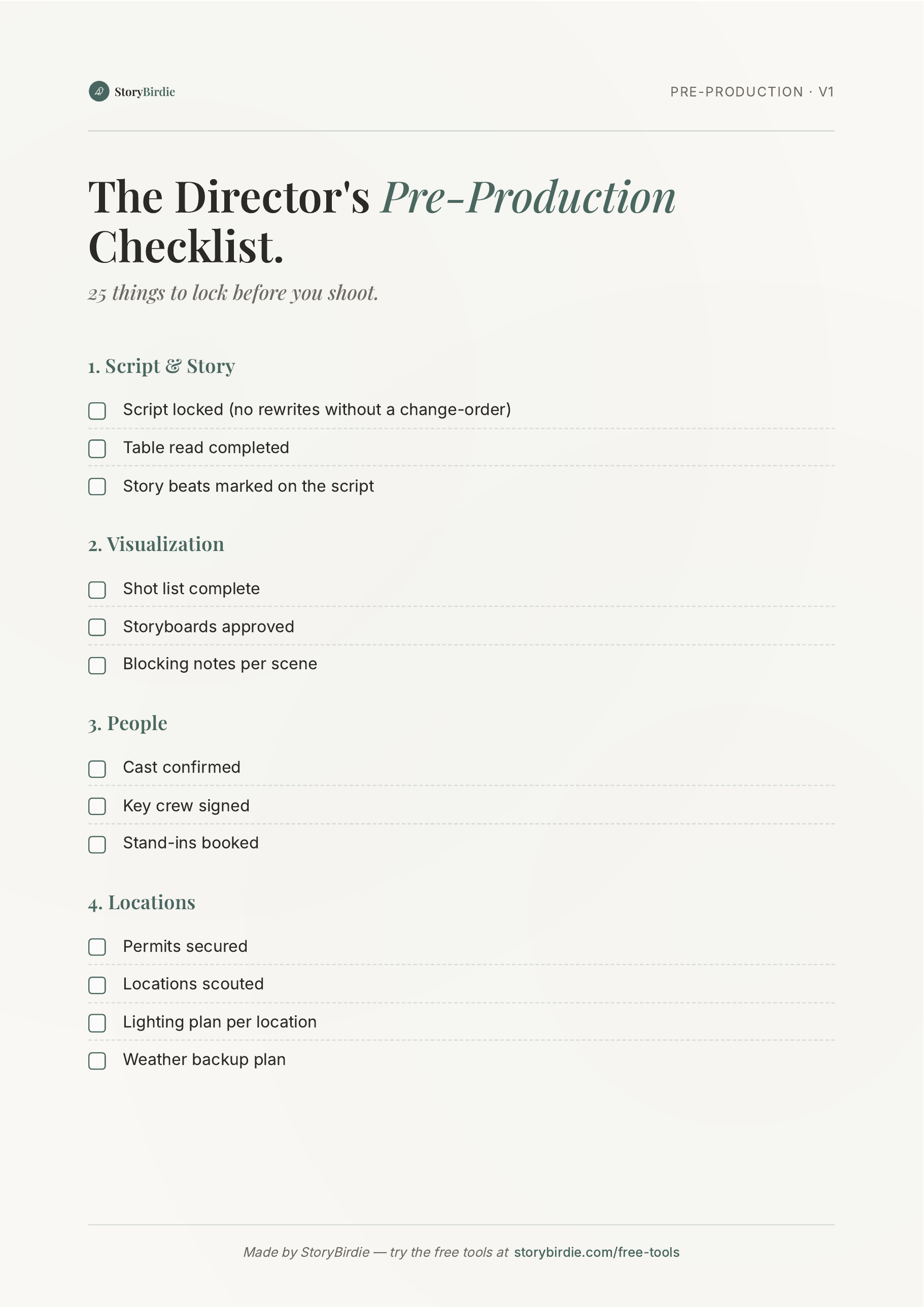
The decisions we put on the page:
- Script & story. Whether the script is locked, table-read, beat-mapped. The script is the input to everything else; if it's still moving, everything downstream is moving.
- Visualization. Whether your shot list is done and your boards are approved. Visualization is where most indie shoots have a hole — directors who can't draw skip the boards and then get to set without a clear plan.
- People. Cast and crew confirmed. Stand-ins booked. The people without whom the shoot doesn't happen.
- Locations, equipment, schedule. The booking decisions. Permits, gear, the locked schedule. These are the ones the producer mostly handles, but the director has to confirm they exist.
- Paperwork. Contracts, insurance, releases. The legal armor. Skip it and the worst case is the project becomes unreleasable.
- Post planning. Editor briefed, post pipeline in place, deliverable specs locked. The handoff to the next phase.
If all 25 boxes are ticked the day before the shoot, you've done pre-production well. If five are unchecked, you're going to lose a day to one of them.
The point of printing it isn't ceremony. It's that a printed checklist is hard to ignore. You walk past it twenty times a day during prep; every unchecked box becomes visible friction. A document on your hard drive doesn't do that.
The workflow that works in practice:
Week 8 (or whenever prep starts), print it and tape it up. Tape it next to your desk, or on the inside of your production office door, or wherever the production team gathers. Not a bulletin board where it gets buried. Somewhere everyone walks past.
Run through it once a week. Pick a day — Friday afternoons work well for most shoots — and walk through it with your producer. Check what's landed, talk through what hasn't, decide who owns the rest. Twenty minutes. The same twenty minutes prevent six different on-set disasters.
Order matters, but loosely. The sections roughly map to the priority order: script first because everything depends on it, then visualization because that's the director's primary deliverable, then the people who make it happen, then locations and equipment, then the paperwork that protects you, then post planning so the edit doesn't start blind. You don't have to hit them in that order, but the earlier sections being unchecked late is a bigger warning than the later sections being unchecked early.
Don't be precious about it. Things drop off. Cast falls through; the location backs out. Cross off the original item, write the new commitment in the margin, move on. The checklist is a working document. The point isn't to keep it clean — it's to keep your attention on what hasn't been resolved.
Hand it to the producer the morning of the shoot. This is the part most directors skip. The checklist becomes the producer's paranoia sheet. Anything still unchecked is a question for the AD before call time. If "permits secured" isn't ticked and you're shooting an exterior at 6am, you want to know that at 5:45am, not when a cop shows up.
A small note on tools. The checklist pairs naturally with the rest of the pre-production toolkit: shot list during visualization week, screenplay breakdown during the people-and-locations weeks, AI screenplay analysis right at the top before "script locked" gets ticked. The checklist tells you what to do; the other tools help you do it.
Honest version: the checklist isn't comprehensive. It's deliberately minimal — 25 items that catch the things that get missed on indie shoots. There's plenty it doesn't cover. Worth knowing what, so you know what other documents to pair it with.
Strip board / shooting schedule. Not on the checklist. The schedule is the 1st AD's job and lives in a different document (Movie Magic, StudioBinder, or a hand-built stripboard). The checklist tells you the schedule has to be locked; the schedule itself is what you lock.
Budget line items. Not on the checklist. The budget is the line producer's job and runs at element-level granularity (catering for 22 people across 12 days). The checklist tells you the budget has to exist; the budget itself is a separate doc.
Per-scene production breakdown. Not on the checklist. That's the screenplay breakdown sheet — one page per scene, cataloging cast, props, wardrobe, makeup, set dressing, vehicles, VFX/SFX, day/night. The checklist tells you visualization and breakdown should be done; the breakdown itself is a separate doc.
Call sheets. Not on the checklist. Call sheets are per-day production documents produced by the 1st AD the day before each shoot day. The checklist tells you a call sheet template should exist; the per-day sheets are made closer to the shoot.
Risk assessments and safety plans. Not on the checklist by default. Most indie shoots don't need formal risk assessments; commercial shoots, anything involving stunts, kids, or animals, or studio-budget productions do. Add a line to the checklist if your shoot needs it — that's what the margin space is for.
Insurance certificates and location releases. Listed under "Paperwork" as one combined item, not broken down per vendor. If you're shooting at five locations, you need five releases — but the checklist just asks whether you've handled releases, not which ones. The line producer or production coordinator tracks per-vendor paperwork.
Marketing and distribution. Not on the checklist at all. The checklist covers up to the post-planning phase, where the deliverables are locked. What happens after delivery — festivals, sales, marketing — is a separate document and a separate problem.
The checklist sits at the level of decision-by-decision: did this happen, yes or no. The other documents sit at the level of execution: how, when, and by whom. You need both. The checklist is just the catch-all that makes sure you don't forget to start the other documents.
One more thing: if you're shooting something where the format doesn't quite fit (a documentary, a music video without traditional cast, a one-day commercial with no post), most items still apply but their weight changes. Use it as a prompt rather than a rule. Cross off what doesn't apply; add what does. The point is the conversation it triggers, not the literal 25 items.